
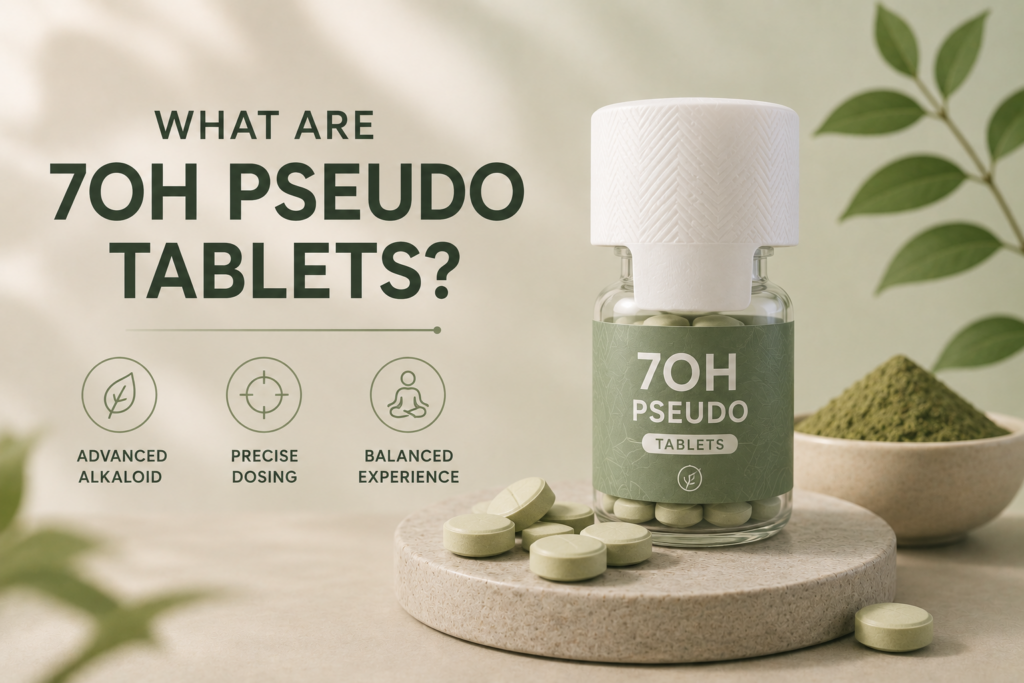
If you have been browsing modern kratom alkaloid products, you may have seen names like 7OH Pseudo tablets, 7OH + Pseudo tablets, or Pseudoindoxyl 7OH tablets.
The name sounds technical, but the idea is easier to understand when you break it down. 7OH Pseudo tablets are tablet-style products that feature two kratom-related alkaloid categories: 7-hydroxymitragynine, often called 7OH, and mitragynine pseudoindoxyl, often shortened to Pseudo.
These products are usually positioned as specialty alkaloid tablets rather than traditional kratom leaf products. That difference matters because 7OH and Pseudo products can be more concentrated, more complex, and more important to compare carefully.
This guide explains what 7OH Pseudo tablets are, what the terms mean, how these products are usually labeled, and what shoppers should understand before comparing them.
Important note: This article is for educational purposes only. Products containing 7-hydroxymitragynine, mitragynine pseudoindoxyl, or other kratom-related alkaloids are not FDA-approved to diagnose, treat, cure, or prevent any disease. The FDA recommends consumers avoid 7OH products and states that products containing 7OH have not been proven safe or effective for any use.
Quick Answer: What Are 7OH Pseudo Tablets?
7OH Pseudo tablets are tablets that contain or are marketed around a combination of 7-hydroxymitragynine and mitragynine pseudoindoxyl.
In simple terms, 7OH refers to 7-hydroxymitragynine, a kratom-related alkaloid found naturally in trace amounts but often concentrated in modern products. Pseudo usually refers to mitragynine pseudoindoxyl, a related compound that has recently appeared in tablet-style drug products and is often found alongside 7-hydroxy mitragynine.
|
Term |
Full Name |
Simple Meaning |
|
7OH |
7-Hydroxymitragynine |
A kratom-related alkaloid often seen in concentrated tablet, shot, gummy, and drink-mix products |
|
Pseudo |
Mitragynine Pseudoindoxyl |
A related compound associated with mitragynine and 7OH |
|
7OH Pseudo Tablets |
7OH + Pseudo tablet products |
Specialty tablets that combine or feature both alkaloid categories |
The key takeaway is simple: 7OH Pseudo tablets should not be treated like regular kratom powder or basic kratom capsules. They are a more specialized product category and require more careful label review.
What Does 7OH Mean?
7OH stands for 7-hydroxymitragynine. It is connected to kratom, but it is not the same as a plain kratom leaf.
In natural kratom, 7OH appears only in trace amounts. The FDA’s concern is mainly around products where 7OH is added or enhanced, including concentrated tablets, gummies, drink mixes, and shots. In July 2025, the FDA issued warning letters to firms marketing products containing 7OH and stated that 7OH is not lawful in dietary supplements, cannot be lawfully added to conventional foods, and is not found in any FDA-approved drug.
For shoppers, that means the most important detail is not just whether a product says “7OH.” It is how much 7OH is included, whether that amount is listed per tablet or per serving, and whether the product includes other alkaloids like Pseudo or MIT.
A clear 7OH tablet product should make the active amount easy to understand. If the label only uses broad words like “strong,” “premium,” or “advanced” without explaining the actual formula, it becomes much harder to compare responsibly.
What Does Pseudo Mean?
Pseudo usually means mitragynine pseudoindoxyl.
This is a more advanced term than 7OH. CFSRE describes mitragynine pseudoindoxyl as a semi-synthetic analogue of mitragynine, the primary psychoactive component in kratom. CFSRE also notes that mitragynine pseudoindoxyl is a metabolite of mitragynine through 7-hydroxymitragynine and that it has emerged in pill and tablet drug products, often alongside 7-hydroxy mitragynine.
That is why Pseudo tablets are often positioned as specialty alkaloid products. They are not usually described in the same way as basic kratom powders or capsules. They are more likely to appear in tablet formulas, dual-alkaloid blends, or advanced product lines.
For buyers, the important question is whether the label clearly separates the Pseudo amount from the 7OH amount. Some products may list each alkaloid separately, while others may only list a combined blend amount.
Are 7OH Pseudo Tablets the Same as Regular Kratom Tablets?
No. 7OH Pseudo tablets are not the same as regular kratom tablets.
Regular kratom tablets or capsules usually focus on kratom leaf powder or mitragynine-dominant extract. 7OH Pseudo tablets, on the other hand, are typically built around concentrated or specialized alkaloids.
|
Product Type |
Main Ingredient Focus |
How It Is Usually Positioned |
|
Regular Kratom Tablets |
Kratom leaf or mitragynine-focused extract |
More traditional kratom-style product |
|
7OH Tablets |
7-hydroxymitragynine |
Concentrated 7OH product |
|
Pseudo Tablets |
Mitragynine pseudoindoxyl |
Specialty alkaloid product |
|
7OH Pseudo Tablets |
7OH + Pseudo blend |
Advanced dual-alkaloid tablet |
This distinction is important because shoppers may see all of these products placed near each other online or in stores, but the formulas can be very different.
How Are 7OH Pseudo Tablets Usually Labeled?
7OH Pseudo tablets may be labeled in a few different ways. Some brands use “7OH + Pseudo,” while others use “Pseudo + 7OH,” “Pseudoindoxyl 7OH,” or “dual-extract blend.”
For example, 7OH.com lists PureOhms 7-OH + Pseudo Tablets as a 4-count chewable tablet product with 120mg total and 30mg per tablet. The product page describes the tablets as a dual-extract blend featuring 7-hydroxymitragynine and mitragynine pseudoindoxyl.
This is exactly why reading the label matters. A product may show a number like 120mg total, but that does not automatically mean 120mg per tablet. In that example, the total pack amount is different from the per-tablet amount. For shoppers, the most useful comparison is usually the per-tablet or per-serving strength, not only the total package strength.
Why Do Some Products Combine 7OH and Pseudo?
Some products combine 7OH and Pseudo because both are connected to kratom alkaloid chemistry and are often marketed as advanced alkaloid formulas.
A 7OH + Pseudo tablet may appeal to shoppers who want a dual-alkaloid product in a compact tablet format. It may also appeal to people who want something easier to compare than powders or liquids because tablets often show a clearer per-unit amount.
However, combination products also require more attention. A shopper should understand whether the label lists the amount of 7OH and Pseudo separately or combines them into one blend number. A separated breakdown gives more clarity. A combined blend amount may still be useful, but it gives less detail about the exact ratio.
The best product pages make this easy. They explain what is in each tablet, how many tablets are in the pack, what the total strength is, and whether any restrictions or warnings apply.
What Makes 7OH Pseudo Tablets Different From 7OH-Only Tablets?
A 7OH-only tablet focuses on 7-hydroxymitragynine. A 7OH Pseudo tablet includes both 7OH and Pseudo, or at least markets itself around that dual-alkaloid combination.
That changes how the product should be compared. With a 7OH-only tablet, the main question is usually, “How much 7OH is in one serving?” With a 7OH Pseudo tablet, the better question is, “How much of the listed amount is 7OH, how much is Pseudo, and is the total shown as a combined blend?”
This is also why two products with the same total milligram amount may not be the same. A 30mg 7OH-only tablet and a 30mg 7OH + Pseudo blend are different formulas. The number may look similar, but the active profile is not identical.
What Should Shoppers Look for on the Label?
The most important label details are the active ingredients, the amount per tablet, the serving size, and the total package strength.
A strong label should make it clear whether the product contains 7OH only, Pseudo only, 7OH + Pseudo, or a broader blend that may also include MIT. It should also explain whether one tablet equals one serving or whether the suggested serving is smaller.
Lab testing is another major trust signal. In this category, a useful lab report can help support claims about 7OH content, mitragynine content, and other alkaloid levels. It can also help shoppers understand whether the product has been screened for contaminants.
Warning language matters too. The FDA has stated that concentrated 7OH products have not been proven safe or effective for any use and should be avoided. The agency has also reported harmful effects associated with 7OH products, including addiction, anxiety, depression, gastrointestinal distress, insomnia, seizures, and withdrawal symptoms.
Are 7OH Pseudo Tablets Strong?
They can be, but “strong” is not a precise enough word.
The strength of a 7OH Pseudo tablet depends on the actual formula, the amount per tablet, the serving size, and whether the product includes other alkaloids. A product with 20mg per tablet is not the same as one with 30mg or 80mg per tablet. A product that separates 7OH and Pseudo amounts is easier to compare than one that lists only a combined blend.
CFSRE reports that mitragynine pseudoindoxyl has been identified in pills and tablets and describes it as having high potency and affinity in cited pharmacology data compared with mitragynine and 7-hydroxy mitragynine. That does not mean every consumer product is the same strength, but it does show why shoppers should avoid casual assumptions and read labels carefully.
A practical way to think about it is this: the product name tells you the category, but the label tells you the real comparison.
Are 7OH Pseudo Tablets FDA-Approved?
No. There are no FDA-approved products containing 7OH. The FDA says 7OH is not approved for medical use and is not lawful as a dietary supplement or when added to conventional foods. The agency has also issued warning letters to companies marketing 7OH products and has recommended consumers avoid them.
This is especially important for product pages and blogs. Brands should avoid saying or implying that 7OH Pseudo tablets treat pain, anxiety, stress, sleep problems, opioid withdrawal, or any medical condition. Those kinds of claims create regulatory and trust issues.
A more responsible content angle is to educate shoppers about ingredients, serving size, label clarity, testing, restrictions, and disclaimers.
Are 7OH Pseudo Tablets Legal Everywhere?
No. Availability can vary by location.
7OH.com product pages commonly show shipping restrictions for certain U.S. states and counties. For example, the PureOhms 7-OH + Pseudo Tablets page lists restrictions for states including Alabama, Arkansas, Indiana, Louisiana, and Wisconsin, along with several county-level restrictions.
The legal picture can also change over time. In July 2025, the FDA recommended scheduling action to control certain concentrated 7OH products under the Controlled Substances Act. The FDA stated that the action targets concentrated 7OH products, not natural kratom leaf products.
Because rules can vary by state, county, and product type, shoppers should always review current restrictions before ordering.
Common Mistakes Shoppers Make
One common mistake is assuming that 7OH Pseudo tablets are just another form of regular kratom. They are better understood as specialty alkaloid tablets.
Another mistake is comparing products by total package strength only. A pack may show 120mg total, but the more useful number may be 30mg per tablet or another per-serving amount.
Shoppers may also overlook the difference between a separated formula and a blended formula. If a label says “30mg blend,” it may not tell you exactly how much is 7OH and how much is Pseudo. That does not automatically make the product bad, but it does mean the buyer has less detail.
The final mistake is treating higher potency as automatically better. With 7OH Pseudo tablets, better usually means clearer labeling, stronger testing transparency, responsible warnings, and legal availability — not just a bigger number.
Final Takeaway: 7OH Pseudo Tablets Are Specialty Alkaloid Tablets
So, what are 7OH Pseudo tablets?
They are tablet-style products that feature 7-hydroxymitragynine and mitragynine pseudoindoxyl. Some products may list both ingredients clearly, while others may describe the formula as a combined 7OH + Pseudo blend.
The smartest way to compare them is to look beyond the product name. Review the amount per tablet, the serving size, the total package strength, the full alkaloid profile, lab testing, warning language, shipping restrictions, and local legality.
For shoppers researching this category, 7OH.com can help compare clearly labeled options by format, potency, brand, and product type. But the most important first step is always the same: read the full product details before making a decision.
FAQs About 7OH Pseudo Tablets
Q. What are 7OH Pseudo tablets?
7OH Pseudo tablets are tablet-style products that contain or are marketed around a combination of 7-hydroxymitragynine and mitragynine pseudoindoxyl.
Q. What does 7OH mean?
7OH means 7-hydroxymitragynine, a kratom-related alkaloid found naturally in trace amounts but often concentrated in modern products.
Q. What does Pseudo mean?
Pseudo usually means mitragynine pseudoindoxyl, a related compound that CFSRE describes as a semi-synthetic analogue of mitragynine and a metabolite related to 7-hydroxymitragynine.
Q. Are 7OH Pseudo tablets the same as regular kratom?
No. Regular kratom products usually focus on leaf powder or mitragynine-dominant extracts. 7OH Pseudo tablets are specialty alkaloid products.
Q. Are 7OH Pseudo tablets FDA-approved?
No. There are no FDA-approved products containing 7OH, and the FDA recommends consumers avoid 7OH products.
Q. What should I compare before buying 7OH Pseudo tablets?
Compare the 7OH amount, Pseudo amount, total active alkaloids, amount per tablet, serving size, lab testing, warning language, shipping restrictions, and local legality.
Q. Can 7OH Pseudo tablets include MIT?
Yes. Some products may include only 7OH and Pseudo, while others may include MIT as part of a broader alkaloid formula.
Q. Are 7OH Pseudo tablets legal everywhere?
No. Availability can vary by state, county, city, and product formulation. Always check current shipping restrictions and local laws before ordering.